
AI Overview
The article analyzes the new wave of generative artificial intelligence integration directly into work tools – from productivity suites to CRMs, to industrial systems – showing how AI is moving from a separate tool to a native component of processes. The central news is the emergence of operational AI agents capable of planning and optimizing marketing campaigns, automating decisions, and generating predictive insights on business data. The impacts on digital marketing, productivity, and process automation are explored in detail, with particular attention to governance and risk management. The text highlights why the real competitive advantage will not only derive from technological adoption but from the ability of companies to rethink roles, workflows, and KPIs in an AI-native key.
Generative AI in Work Tools: How it Changes Productivity, Marketing, and Business Processes
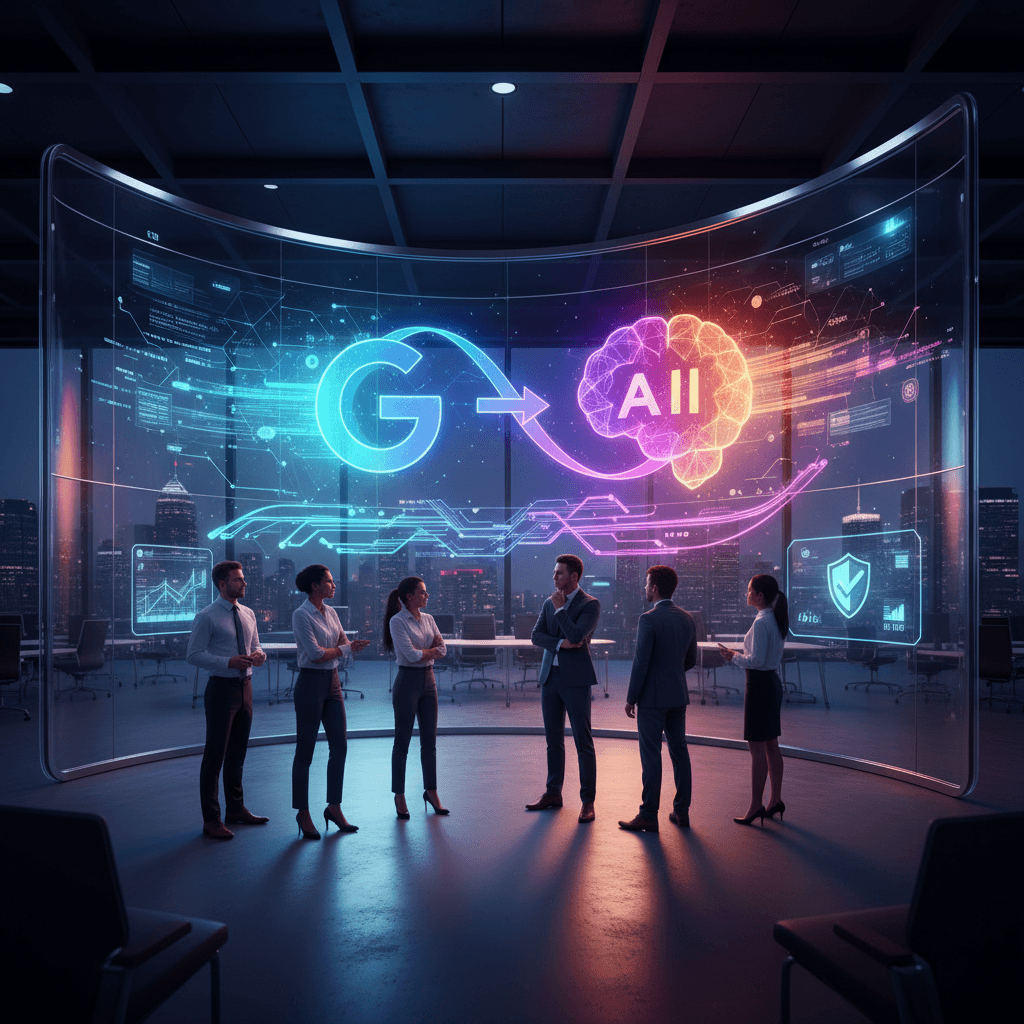
In recent days, a series of coordinated announcements by major software players – from collaboration platforms to productivity suites and CRMs – has accelerated an already evident trend: Generative AI no longer lives in separate products but is natively integrated into the work tools that companies already use every day.[3][4]
We are not just talking about "assistants" that summarize emails or generate texts, but about operational AI agents capable of planning, executing, and optimizing entire workflows: from managing digital marketing campaigns to qualifying leads, from analyzing sales data to automating internal processes.[3][4]
This pervasive integration marks a phase transition: after the era of pilot tests and isolated experiments, daily productivity and digital marketing are being rethought "AI-native", directly within the work tools.[1][3][4]
From the "Separate Tool" Model to the "AI-Native" Model
Why Native Integration is Relevant News
In the last two years, many companies have experimented with generative AI through separate or vertical web interfaces (chatbots, copy assistants, image generators), often disconnected from core business systems.[2][4]
The novelty of recent weeks is the convergence of three movements:
- Productivity suites are introducing contextual AI assistants that read documents, spreadsheets, chats, and company emails to generate output directly in the workflow.[4]
- CRM and marketing automation providers are launching agentic AI functionalities that independently set up campaigns, segmentations, and reports, interacting with real data from customers and prospects.[3][4]
- AI-native development and orchestration platforms are emerging, allowing marketing, operations, and IT to define agents and workflows using natural language.[3]
The result is a paradigm shift: you don't "open an AI" to do a task, but the AI lives within the tools, observes what the user does, and proposes actions, automations, and optimizations in real-time.[1][3]
From Simple Automation to Operational Agents
A significant difference compared to previous waves is the proactive nature of these systems:
- They don't just respond to requests (e.g., "write an email"),
- But they are able to plan, execute, and monitor complex processes (e.g., "launch a campaign, monitor the results, reallocate budget where it performs best").[3][4]
This trend is described as the transition to Agentic AI, i.e., software that acts as "digital colleagues" and not as simple support tools.[3]
Impact on Digital Marketing: The Media-Mix Becomes Algorithmic
Campaign Planning: From Creativity to Algorithmic Direction
With the native integration of generative AI into advertising and marketing automation platforms, media planning changes in three key dimensions:
- Generation of creative variations: AI automatically produces headlines, copy, images, and ad structures differentiated by segment, channel, and funnel stage, drawing on historical performance data.[3][4]
- Continuous optimization: AI agents analyze CPC, CPA, ROAS, conversion rate in real-time and propose – or directly apply, based on policies – budget shifts and targeting changes.[3]
- Dynamic segmentation: Segments are no longer static but are updated based on behavioral signals, viewed content, multi-channel interactions, and conversion probabilities calculated by predictive models.[4][6]
The marketer goes from operational executor to strategic director, called upon to define objectives, constraints, and metrics, while AI agents orchestrate the details.[3]
Content, SEO, and Personalization
On the content and SEO front, AI integrated into CMS and analytics platforms enables new practices:
- Automatic analysis of SERPs and search intents, with suggestions of thematic clusters and pillar content more consistent with user queries and brand strategy.[3]
- Generation of multi-format content (text, images, basic videos) starting from strategic briefs, with variations calibrated for different micro-segments of the audience.[2][3]
- On-site personalization in real-time: AI modifies texts, offers, and displayed content based on user behavior and their predictive profile, leveraging models that combine navigation data, CRM, and purchase history.[4][6]
In parallel, the issue of digital provenance and labeling of AI-generated content is pushing platforms and companies to adopt watermarking and traceability systems to distinguish between human and synthetic productions, with direct impacts on brand safety.[3]
Measurement and Attribution: Fewer Vanity Metrics, More ROI
The integration of AI agents with analytics and data warehouse systems allows for more granular attribution and a greater ability to model "what if" scenarios:
- AI simulates budget shifts between channels and tactics, estimating the impact on primary KPIs (revenues, qualified leads, LTV) and not just on surface metrics.[4][6]
- Hybrid attribution models are proposed, combining deterministic rules and probabilistic signals derived from machine learning models.
- Reports are transformed into narrative reports: not just tables, but self-generated discursive analyses that highlight anomalies, opportunities, and risks.[4]
AI and Business Automation: Towards Truly Data-Driven Processes
From RPA to Operational AI
On the front of business process automation, generative AI integrated into management tools (ERP, ticketing systems, workflow platforms) allows overcoming the classic perimeter of rule-based RPA.[6]
The main evolutions concern:
- Semantic understanding of emails, documents, customer requests, and support tickets, with automatic sorting, information enrichment, and proposal of response or action.[4][6]
- Decisional automation in structured processes (e.g., approval of discounts, priority in production, inventory management) through predictive models that estimate risks and benefits of different options.[6]
- Human-machine integration: workflows in which AI proposes, humans validate, and AI executes on a large scale, with a continuous feedback loop that updates the models.[4]
Intelligent Dashboards and Predictive Analysis
In the industrial and operational context, the combination of generative AI and analytics systems leads to the creation of conversational dashboards and embedded predictive engines:[6]
- Managers can query data with natural language ("show me the main causes of the decline in margins in the last quarter") and receive analyses explained in discursive form, with dynamically generated graphs.[6]
- Predictive models estimate demand, failures, delays, and performance trends, allowing to anticipate critical issues and optimize stocks, maintenance, and production capacity.[6]
- The same AI can suggest concrete interventions (e.g., "reduce the production of this line by 10% to avoid overstock in the next 30 days") based on simulated scenarios.[4][6]
Governance, Risk, and Responsibility
The organizational-scale adoption of AI embedded in work tools poses governance and risk challenges that various international analyses are highlighting:[4]
- Clear definition of responsibility between decisions made by AI and decisions validated by humans.
- Implementation of data access policies to prevent AI agents from learning from unauthorized sensitive information.[4]
- Continuous monitoring of model performance to reduce biases, systematic errors, and unforeseen drifts in automated processes.[4]
For many companies, 2026 is indicated as the year in which AI will cease to be an individual tool and become a structured organizational resource, with dedicated roles, budgets, and metrics.[4]
Impact on Business
Productivity: The Most Visible Lever, But Not the Only One
The immediate effect of generative AI integrated into daily tools is a tangible increase in individual and team productivity:
- Drastic reduction of time spent in repetitive and low-value activities: reports, routine emails, internal requests, preliminary research.[3][6]
- Acceleration of analysis, synthesis, and preparation phases of materials (presentations, strategic documents, business cases), thanks to assistants that operate on company data and documents.[4][6]
The economic value does not only derive from "doing the same things faster" but from the possibility of doing new things: testing more campaign variations, exploring more decision-making scenarios, personalizing at a scale impossible with human teams alone.[3][4]
Marketing and Sales: From Linear Funnel to Data-Driven Cycle
For commercial and marketing functions, the impact is particularly strong:
- The funnel from TOFU to conversion becomes a dynamic cycle, in which each interaction feeds the models and improves the next, from creativity to the commercial proposal.[3][4]
- Lead qualification is based on predictive scoring integrated into the CRM, which estimates the probability of conversion and suggests the next-best-action for each contact.[4]
- Collaboration between marketing and sales is structured around shared metrics (e.g., pipeline generated by AI, conversion rate of leads handled by agents compared to those managed manually).[4][6]
Companies that are adopting AI embedded in go-to-market processes more quickly report shorter sales cycles, better margins, and a greater ability to react to market changes.[4][6]
Operations and Industry: Truly Operational Data-Driven Decisions
In the industrial, logistics, and operations world, AI integrated into management tools produces impacts on:
- Reduction of operational risks, thanks to systems that anticipate critical issues and propose mitigation plans.[6]
- Better allocation of resources (machines, people, capital), based on demand scenarios and production constraints generated by the models.[6]
- Decision-making transparency, with logs and discursive explanations of AI recommendations, useful both for internal trust and for audits and compliance.[4]
For many manufacturing companies, this means moving from simple process digitization to a true data-driven model, in which data is not only tracked but becomes an explicit driver of daily operational decisions.[6]
Competitive Advantage and Barriers to Entry
From a strategic point of view, the native integration of AI into work tools tends to reduce technical barriers to entry but increases organizational and cultural barriers:
- On the technical level, access to advanced functionalities is increasingly plug-and-play, integrated into already adopted software, without the need to build complex technology stacks from scratch.[3][4]
- On the organizational level, however, the competitive advantage will go to companies that know how to:
- Rethink roles, processes, and KPIs in an AI-native way,
- Invest in training and upskilling to transform the workforce into "AI-augmented",
- Define a clear governance and a long-term strategy on the use of AI.[4][6]
In other words, technology tends to become democratized, but the ability to transform it into concrete results remains profoundly differentiating.
What Companies Should Do Now
The acceleration of generative AI in work tools poses some immediate priorities for businesses, marketers, and decision-makers:
- Map where AI is already present in the tools in use and understand exactly what it does, with what data, and with what responsibilities.[4]
- Define internal guidelines on the use of generative AI: permitted areas, levels of human supervision, approval processes for campaigns, content, and critical decisions.[4]
- Start pilot projects focused on measurable processes (e.g., a specific marketing flow or a well-defined operational process) to quantify impacts and scale only where the ROI is clear.[6]
- Invest in hybrid skills: figures capable of communicating with IT, marketing, operations, and legal to orchestrate the adoption of AI agents coherently at the company level.[4]
Those who manage to coordinate these elements will be able to transform the integration of generative AI into work tools from a simple functional upgrade to a true business model transformation lever.
Sources & References
Pronto a trasformare il tuo business?
Digital Mirror non si limita a raccontare il futuro: lo costruiamo. Scopri come l'Intelligenza Artificiale può scalare la tua azienda oggi stesso.