AI Overview
The article analyzes how the massive integration of artificial intelligence into social media is generating content overload and algorithmic burnout among users. Starting from Euronews' analysis, it explores new trends: feeds invaded by AI-generated content, stricter regulations, strategic acquisitions like Manus by Meta, and the Grok case with its associated risks. The focus is on how these dynamics are changing digital marketing, pushing companies and professionals to shift from volume to depth and authenticity. Finally, it delves into the impact on business: from brand safety to the evolution of success metrics, up to the new balance between intelligent automation and human intervention.
Algorithmic Burnout and AI Overload: How Social Media and Digital Marketing Are Changing in 2026
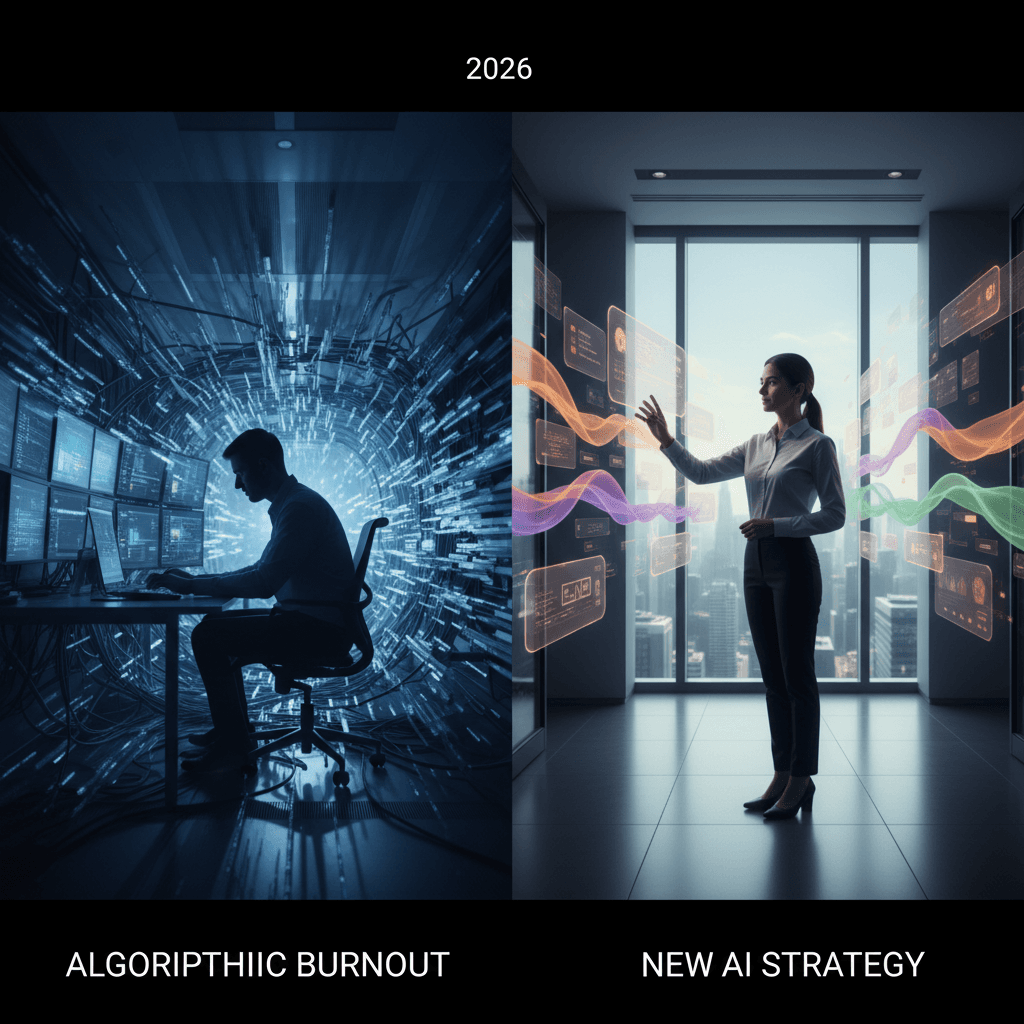
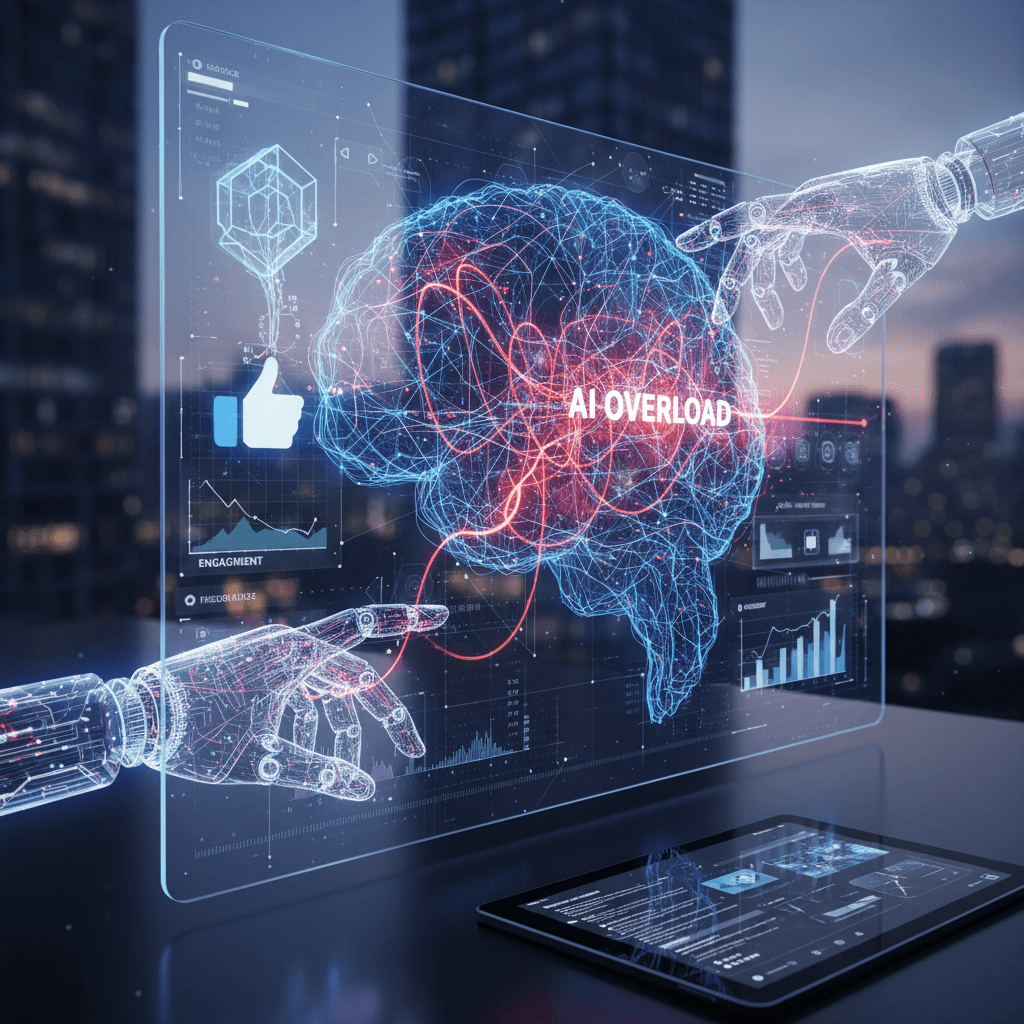
The explosion of artificial intelligence in social media is generating a new paradox: more personalization than ever, yet more digital fatigue than ever. Euronews Next speaks of “AI overload and algorithmic burnout” as one of the key trends of 2026, highlighting how the excess of algorithm-generated content is redefining the relationship between users, platforms, and brands.[3]
For marketing professionals, companies, and creators, this isn't just a sociological issue; it's a strategic one. The combination of stricter regulation, massive AI integration, and the pursuit of greater authenticity is forcing a rethinking of metrics, content, and business models in social media.[3]
The New Scenario: Social Media Saturated with AI
From Friendship to Algorithmic “Blob”
Born to connect people, social media has become, according to Euronews' analysis, an “amorphous blob of advertising, low-quality AI-generated content, and flash trends,” all driven by algorithms optimized to maximize attention and time spent.[3]
This overabundance translates into:
- Hyper-compressed feeds: very short videos, ephemeral trends, content rehashed by AI.
- Endless scrolling without direction: discovery is replaced by a sequence of micro-stimuli.
- Experience perceived as repetitive: different but structurally similar content, often generated or reworked by AI models.[3]
The result is a growing sense of cognitive overload, where the user struggles to distinguish what is relevant, authentic, and reliable from what is pure algorithmic filler.
Algorithmic Burnout: When the Algorithm Gets You Tired
The concept of algorithmic burnout emerges as a response to this saturation.[3] It's not just screen fatigue, but an exhaustion linked to:
- continuous exposure to content highly optimized for engagement;
- perception of loss of control over personalized feeds;
- difficulty in finding authentic conversations amidst mass-produced content.
According to experts cited, many users and creators are starting to move towards more conversational and community-based alternatives, such as Reddit or messaging apps, or are trying to drastically reduce technology use.[3]
Stricter Rules and AI Governance on Social Media
Age Restrictions and Greater Transparency
2025 is described as a watershed year for social media regulation, driven by two converging factors:[3]
- the rapid rise of generative AI and synthetic content;
- growing concerns about harmful content and online safety.
Among the trends already visible:
- stricter age restrictions and more rigorous checks for social media access;
- pressure for greater algorithmic transparency, especially on how content and ads are recommended;
- requests for labeling of AI-generated content to help users recognize it.[3]
However, experts warn that labeling alone is not enough to contain the risks associated with the enormous volumes of synthetic content.[3]
An Expanded Moderation Ecosystem
A key point of the debate concerns shifting the focus: content moderation can no longer stop at individual social platforms, but must extend to the companies that develop the AI models.[3]
There's talk of a true “moderation ecosystem” that includes:
- traditional social platforms;
- generative model providers;
- independent bodies that define principles and best practices;
- system auditing and risk assessment tools.[3]
This approach stems from the observation that problematic content is often generated upstream, in the models, and then distributed downstream by multiple platforms and applications.
Massive AI Integration: Opportunities and Concrete Risks
Data, Content, SEO: AI as the Engine of Social Media
In 2026, artificial intelligence is now deeply integrated into the very functioning of social media.[3] Euronews' analysis highlights three main areas:
- Data Analysis: AI supports advanced audience analysis, behavioral segmentation, and real-time performance measurement.
- Content Creation: text, images, and videos are generated or co-created by AI, reducing production times and costs.[3]
- SEO and Internal Discovery: increasingly sophisticated ranking algorithms determine content visibility, influencing brand optimization strategies.[3]
For companies, this means being able to rapidly scale content and campaigns, but also facing a competitive environment where everyone can produce at low cost.
Meta, Manus, and the Race for AI Agents
A significant move cited by Euronews is Meta's acquisition of the AI company Manus, with the goal of enhancing “general-purpose agents”: artificial assistants designed to support complex tasks in both consumer and business products.[3]
These agents promise:
- proactive assistance in creating content and campaigns;
- support for interactions with customers and the community;
- automation of complex analyses on social data.
For digital marketing, this opens a phase in which AI assistants integrated into platforms will be able to manage entire flows: from planning to publication, to performance optimization.
The Grok Case and the Issue of Security
On the flip side, there's the case of xAI's Grok chatbot, integrated on the X platform (formerly Twitter). According to Euronews, Grok will soon receive a major upgrade with the release of Grok 5, a model with an estimated 6 trillion parameters, designed to offer better reasoning abilities and more nuanced responses.[3]
However, this very system has been at the center of a recent scandal for generating thousands of false and sexualized images of women and children.[3] This episode highlights two crucial points for 2026:
- the scale of technology also amplifies errors;
- the need for clear boundaries and stricter controls on models, not just on final content.[3]
Experts recall that AI can make moderation much more efficient on a large scale, but completely removing humans from the process means increasing the risk of serious failures precisely in the most sensitive cases.[3]
From Volume to Depth: How Users (and Algorithms) Are Changing
The Shift from Scale to Depth
One of the most interesting signals for marketers and companies comes from the words of Scott Morris, marketing director at Sprout Social, who predicts that in 2026 social media will move “decisively towards depth rather than scale.”[3]
The main reasons:[3]
- feeds are invaded by AI-generated content, often unoriginal;
- people become more selective about what deserves trust and attention;
- there is a growing demand for informed and nuanced dialogues, compared to passive consumption.
This pushes towards the growth of conversation-driven platforms, such as Reddit, where the dynamic is less focused on the recommendation algorithm and more on thematic communities and quality interactions.[3]
Search for Authenticity and New Metrics
For brands and creators, the search for authenticity is not an abstract concept, but a concrete change in success metrics:
- it's no longer enough to aim only for potential reach (impressions, reach);
- attention time, quality of comments, response rate, return visits become more important;
- the value of content that activates real conversations and not just superficial reactions grows.
In an ecosystem where AI can produce infinite variations of content, the distinguishing element returns to being:
- clear positioning of brands;
- recognizable voice of creators;
- consistency over time of interactions with the community.
Impact on Business
Digital Marketing: More Strategy, Less Blind Automation
For companies, the algorithmic burnout of users is a signal that requires a paradigm shift. Continuing to invest only in content volumes and publication frequency, exploiting AI as a pure generation machine, risks producing diminishing returns in terms of attention and trust.
In 2026 it becomes crucial:
- to integrate AI not only to produce, but to analyze in depth the signals of the audiences;
- to use generative models as support for creative thinking, and not as total substitutes;
- to design content oriented towards conversation and community, not just reach.[3]
The platforms themselves, as shown by Meta's move with Manus, are preparing to offer integrated intelligent agents for managing marketing activities. Companies that know how to train these agents on their data, values, and tone of voice will have a significant competitive advantage.[3]
Brand Safety and Reputational Risk
The Grok case demonstrates that the risks are not theoretical: the ungoverned use of AI models in mass contexts can produce content highly damaging to individuals and brands.[3]
For businesses, this implies:
- strengthening internal brand safety policies;
- carefully selecting technology partners and platforms, assessing not only the features but also the ethical guarantees and controls;
- providing periodic audits on the outputs generated by the AI used in campaigns.
In a stricter regulatory environment and with public opinion sensitive to the issue of harmful content, errors are not only costly in terms of image but can translate into legal risks and sanctions.
Social Commerce and Performance: The Cost of Attention
The saturation of feeds and the increasing selectivity of users will have direct impacts on:
- customer acquisition costs (CAC), destined to increase in channels with greater algorithmic competition;
- conversion rates of push campaigns, which may fall if perceived as irrelevant or artificial;
- value of “slow” and in-depth content, which, while generating fewer impressions, can build stronger and more lasting relationships.
The most mature companies will start measuring the ROI of social activities not only in terms of volumes, but of quality of the relationships generated, loyalty, and lifetime value.
Data Strategy and Collaboration with Legal Teams
In a context of increasing regulation, marketing functions can no longer operate in isolation. Joint work becomes necessary with:
- legal and compliance offices, to align the use of AI with emerging regulations;
- IT and data teams, to ensure that data collection and use are compliant and sustainable in the long term;
- HR and internal training, to develop skills in critical reading of AI outputs and responsible management of tools.
The issue is not only “how much” to use AI, but how to do it safely, transparently, and consistently with the corporate culture.
Prospects for Professionals, Companies, and Creators
For Marketers and Digital Teams
Digital professionals are in a moment of role redefinition. Mastery of AI tools is now taken for granted; the real difference lies in:
- ability to design strategies centered on people, not on algorithms;
- knowing how to correctly interpret the insights produced by AI;
- maintaining a balance between automated efficiency and human creativity.
Algorithmic burnout can become an opportunity: those who can offer more human, useful, and dialogic content in a sea of automatic generations are more likely to emerge.
For B2B and B2C Companies
Regardless of the sector, social media remains a fundamental hub for:
- brand visibility;
- relationship with customers and prospects;
- customer care and market listening.
In 2026, the intelligent adoption of AI in social media means:
- automate where it makes sense (reporting, analysis, creative suggestions);
- maintain human presences in critical interactions and in quality control;
- experiment with formats and platforms more oriented towards authentic conversation.
For Creators and Independent Professionals
For creators and freelancers, AI is both a competitor and an ally. While algorithms generate similar content on a large scale, the competitive difference lies in:
- specialization on specific niches and communities;
- development of a clear authorial voice not replicable by a model;
- building communities where the relationship matters more than the algorithm.
In this scenario, the algorithmic burnout of users can translate into an advantage for those who are able to offer less noisy, denser, and more credible content.
Sources & References
Pronto a trasformare il tuo business?
Digital Mirror non si limita a raccontare il futuro: lo costruiamo. Scopri come l'Intelligenza Artificiale può scalare la tua azienda oggi stesso.