
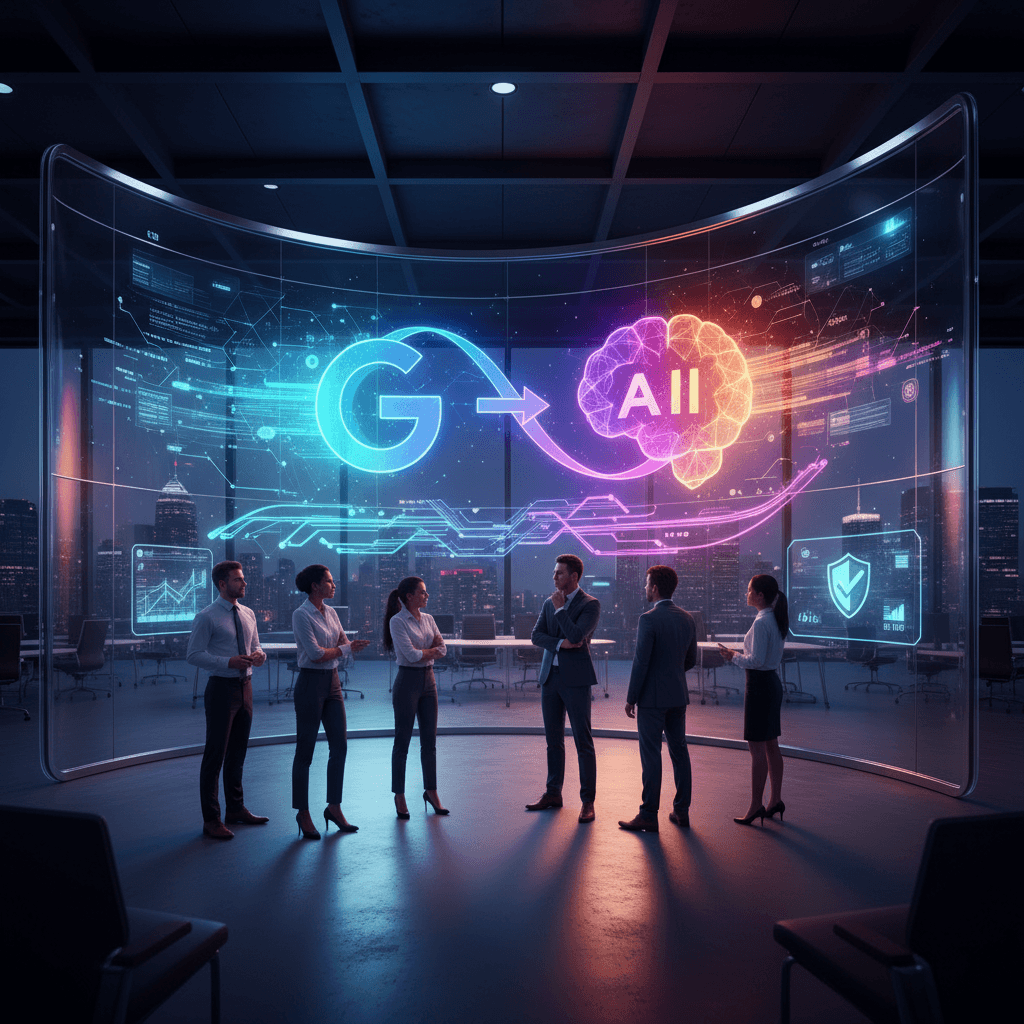
AI Overview
In 2026, Google's Search Generative Experience introduces a radical change in how online search works. It's not just about getting to the first page, but about becoming a reliable source that Google decides to cite directly in its AI responses. This article explores how AI Mode redefines the concept of visibility, why E-E-A-T criteria have become fundamental, how GEO (Generative Engine Optimization) strategies can increase visibility by up to 40%, and what concrete actions companies must take to remain visible in an ecosystem where credibility is the new competitive asset.
Related service: SEO and Google ranking — packages, process and quote.
The Search Revolution: Google SGE and AI Mode in 2026
Google has marked a decisive turning point in how online search works. In 2026, the introduction of the Search Generative Experience (SGE) and the new AI Mode represents a radical transformation that goes beyond a simple algorithmic update: it is a complete paradigm shift in how users find information and, above all, how companies must position themselves online[1][2].
For years, SEO has focused on a simple goal: reaching the top position on the search page. In 2026, this logic has been completely overturned. It's no longer about coming first, but about becoming the source that Google decides to cite directly in the AI response. This change represents an unprecedented challenge for digital marketing professionals and companies who must completely rethink their online visibility strategy.
How the New Search Generative Experience Works
The SGE introduces an innovative concept: instead of immediately redirecting to a website, Google proposes a structured response directly on the search page[3]. The user receives complete, contextualized, and relevant information without having to click on any links. This approach solves a fundamental problem of traditional search: the need to manually filter through dozens of results to find a useful answer.
What makes SGE truly revolutionary is the ability of generative artificial intelligence to create original and personalized content directly in the SERP. AI analyzes user behavior, their previous preferences, and the context of the search to provide responses that adapt to the specific needs of each individual[1]. Two users searching for the same information could receive completely different results, optimized for their interests and background.
AI Mode: Transparency as a New Standard
But there is an even more important aspect: the introduction of Google AI Mode, which completely transforms the concept of credibility in search. Unlike previous search systems, AI responses are no longer opaque "black boxes." Google explicitly shows sources, reference links, and additional context, making the search transparent and traceable[2].
This means that when Google generates a response, it includes:
- Direct links to the sources used
- Contextual citations that show exactly where the information comes from
- Content selected based on quality, authority, and accuracy
- Brand credibility signals that indicate to the user whether the source is reliable
This transparency is revolutionary because it radically changes the metric of SEO success. You not only have to be found; you have to be chosen as a reliable source by Google itself[2].
The New Standard: E-E-A-T Is Now Fundamental
Google continues to strengthen the E-E-A-T (Experience, Expertise, Authoritativeness, Trustworthiness) criteria, but in 2026 these are no longer additional elements. They have become the foundation on which Google builds AI responses[2].
For a website, this means:
- Eliminating superficial and generic content
- Focusing on in-depth, technically sound texts based on real research
- Making the brand identity and the quality of its expertise clear
- Demonstrating concrete experience in the sector, not abstract theories
- Providing case studies, practical examples, and measurable results
SEO is no longer just a technical matter of on-page optimization and link building. It has become a value positioning, where the perceived quality of the content determines whether Google will consider you worthy of being cited in the AI response[2].
GEO: The New Frontier of Optimization
To address this new reality, a new concept has emerged: GEO (Generative Engine Optimization). This is the natural evolution of traditional SEO, which focuses on optimizing not only for conventional search engines but specifically to be cited and referenced in AI-generated responses[4].
Research conducted by Princeton University and Georgia Tech has shown that GEO strategies can increase visibility in generative engines by up to 40%[4]. This is not a number to be underestimated: it represents the differential between visibility and invisibility in the new search ecosystem.
The Concrete Impact on User Habits
With AI Mode, users have access to faster answers, structured information, and alternatives validated by reliable sources. The click becomes a more selective and conscious gesture. The user no longer clicks on any result in the hope of finding useful information; they only click if the brand demonstrates authority already in the AI response itself[2].
This has two important consequences:
-
For those who appear among the sources: Organic traffic will be more qualified, less dispersed, and with a greater intention to purchase or engage. The user arrives at your site already knowing who you are and why you should be trusted.
-
For those who do not appear: Risk a significant contraction of organic visibility, regardless of how good the content is. If Google does not consider you worthy of citation, your site becomes "invisible" to those using AI Mode.
How Brand Communication Changes
The direct impact on brands is immediate and concrete. Communication must evolve on four fronts:[2]
1. Verifiable authenticity: Demonstrate who you really are, with verifiable faces, stories, and backgrounds. Not generic, but concrete.
2. Verifiable competence: Provide case studies, practical examples, measurable results. Theory is no longer enough.
3. Brand consistency: The voice, method, and communicative quality must be consistent across the site, blog, social media, and services. Dissonance is penalized.
4. Depth: AI responses extract value from content. If there is no depth, your content will not be selected, regardless of how well it is technically optimized.
Monitor the New Visibility: Beyond the Traditional SERP
A crucial aspect that many marketing professionals still do not fully understand is that real visibility is moving from the traditional positioning in the SERP to the conversational block of AI responses[2]. Traditional SEO monitoring tools do not measure this. If you only monitor the traditional rank, you are looking in the wrong places.
The true digital visibility in 2026 is no longer automatic. It is earned[2]. You must demonstrate value, credibility, and reliability to be considered worthy of citation.
The Impact on Business: Concrete Strategies for 2026
How does all this translate into concrete strategies? Companies and marketing professionals must make a significant change of direction:
Research and specialization: Do not try to be generic. Specialize in niches where you can demonstrate authentic value. Google prefers specialized sources to generalist content.
Content as an asset: Investing in content is no longer optional. It must become a strategic priority. In-depth articles, whitepapers, original research, exclusive data: this is what Google considers worthy of citation.
Authority building: Contribute to authoritative publications, participate in industry research, build a verifiable reputation in your field. Authority is the new competitive asset.
User experience: The site must be intuitive, fast, mobile-first. The structure of the content must be clear. If the AI has to extract value from your site, it must be able to do so easily.
Transparency and verifiability: Publish information about who you are, what your credentials are, who works in your company. Transparency is not optional; it is an evaluation criterion.
Conclusion: 2026 Is the Year of Credibility
2026 represents a point of no return for SEO and online visibility. Google SGE and AI Mode are not simple algorithmic updates; they are a complete redefinition of value and credibility on the web. Companies and marketing professionals who do not adapt to this new reality risk becoming progressively invisible, regardless of how well they optimize their sites according to traditional SEO standards.
The message is clear: in 2026, positioning is no longer guaranteed by ranking. It is guaranteed by credibility, specialization, and the ability to demonstrate authentic value. The future of online visibility belongs to those who understand and embrace this transformation.
Sources & References
- https://www.emmelab.it/google-sge-nel-2026-come-lia-generativa-cambiera-per-sempre-la-ricerca-online/
- https://www.digife.it/google-ai-mode-rivoluziona-la-ricerca-cosa-cambia-per-seo-e-brand-nel-2026/
- https://www.agenziaspada.com/2025/12/seo-2026-come-cambiera-lottimizzazione-tra-ai-sge-e-ricerca-multimodale/
- https://presenzainrete.it/blog/seo-ai-ottimizzare-contenuti/
Pronto a trasformare il tuo business?
Digital Mirror non si limita a raccontare il futuro: lo costruiamo. Scopri come l'Intelligenza Artificiale può scalare la tua azienda oggi stesso.