
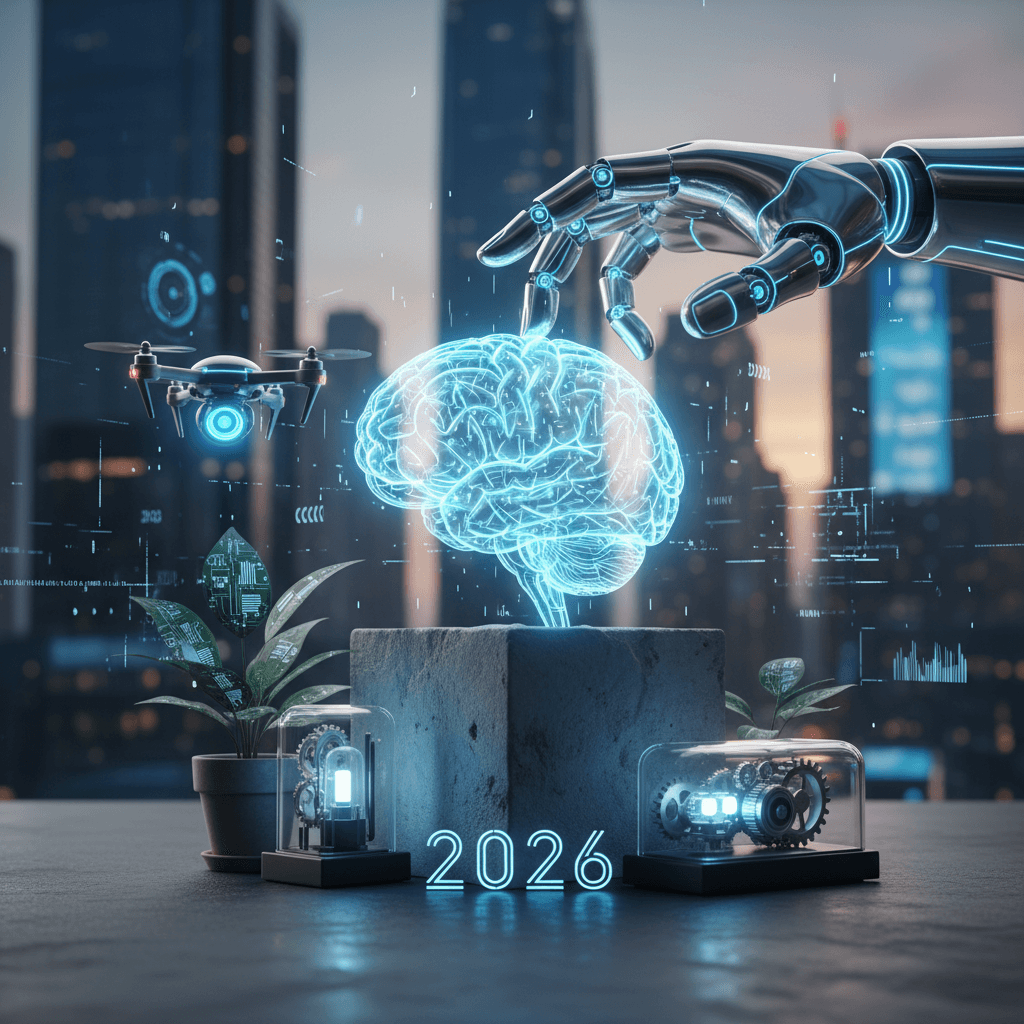
AI Overview
Physical AI emerges as a dominant trend in 2026 because it merges artificial intelligence with physical hardware, allowing robots, drones, and IoT to act autonomously in the real world based on on-device neural decisions. This solves past limitations such as latency and cloud dependence, revolutionizing logistics, production, and marketing with precise and reactive automations. For businesses, it means reduced costs, amplified productivity, and new phygital customer experiences, opening markets worth billions. The convergence with edge computing and artificial vision makes it accessible even to SMEs, laying the foundation for a more resilient and innovative business.
Related service: AI and chatbots — packages, process and quote.
Physical AI: Artificial Intelligence Enters the Real World in 2026
In an era where artificial intelligence is no longer confined to screens and remote servers, 2026 marks the rise of Physical AI, an epochal convergence between AI and hardware that is revolutionizing robotics, logistics, and IoT devices. Imagine robots that not only collect data but also act in real-time on the physical environment, autonomous drones that optimize complex deliveries, and intelligent sensors that make on-device decisions without relying on the cloud. This trending news, which emerged strongly in this week's tech analysis, promises to transform business processes, making them more efficient, autonomous, and responsive. For digital marketing professionals and companies seeking automation, Physical AI is not science fiction: it is the next practical frontier.[1]
What is Physical AI and Why Is It Exploding Right Now
Physical AI represents the deep integration between artificial intelligence models and physical hardware components, enabling machines and devices to interact directly with the real world. Unlike traditional AI systems confined to the digital realm, such as chatbots or text generators, Physical AI enables physical actions based on neural decisions processed on-site. In 2026, this technology sees a "massive convergence" between AI and hardware, with applications in advanced robotics for warehouses, drones for inspections, and IoT that transitions from passive to proactive.[1]
The Technologies Behind the Change
At the heart of Physical AI are on-device neural models, i.e., AI algorithms that run directly on chips embedded in devices, reducing latency and reliance on internet connections. This is made possible by advancements in Edge Computing and specialized chips such as those based on neuromorphic computing, which mimic the human brain for efficient processing. For example, a logistics robot does not simply scan barcodes: it analyzes the environment in real-time, predicts obstacles, and autonomously reorganizes routes.[1][2]
Another pillar is advanced artificial vision, enhanced by hybrid neural networks that process images, videos, and sensory data with pinpoint accuracy. OpenAI and other leaders are pushing these capabilities toward robotics, where models interpret natural commands and adapt to dynamic contexts, such as variable industrial environments.[2]
Practical Applications in 2026: From Logistics to Production
Physical AI is already impacting key sectors. In logistics, autonomous robots manage complex flows of goods: imagine warehouses where robotic arms coordinated by physical AI move heavy pallets, optimizing spaces and reducing human errors by 40-50% according to recent estimates. Drones equipped with Physical AI perform inspections on remote plants, detecting faults before they happen.[1]
Concrete Examples of Implementation
- Industrial Robotics: Factories adopt cobots (collaborative robots) with Physical AI for precise assemblies, integrating tactile and visual feedback to work side-by-side with humans.
- Intelligent IoT Devices: Sensors in supply chains not only monitor temperatures but also activate corrective actions, such as activating a cooler or diverting shipments.[1][5]
- Autonomous Drones: Used in agriculture to spray targeted pesticides or in urban deliveries, navigating urban obstacles with on-board AI decisions.[1]
These applications are not theoretical: experts such as Valeria Portale of the Politecnico di Milano predict an "acceleration" of these evolutions in 2026, with the digital integrating into synergistic systems.[5]
Impact on Business: Automation that Generates Real Value
For companies, Physical AI is not a cost, but a productivity multiplier. It reduces downtime by 30% in logistics, cuts operating costs through on-device automation, and unlocks new revenue streams, such as predictive maintenance services. In digital marketing, it integrates phygital experiences: campaigns that connect the physical and digital worlds, such as smart storefronts that personalize offers based on physical AI that detects customer behavior.[1]
Competitive Advantages for SMEs and Large Enterprises
| Aspect | Impact on Business | Practical Example |
|---|---|---|
| Operational Efficiency | 70% latency reduction with edge AI | Robotized warehouses that process orders in seconds [1] |
| Scalability | Low-cost devices with on-board AI | IoT for SMEs without massive cloud investments [3] |
| Security | Local decisions reduce data risks | Robots that avoid collisions in real-time [2] |
| Personalization | Contextual analysis for marketing | Stores with AI screens that adapt ads [1] |
Italian companies, already leaders in manufacturing, can leverage Physical AI to compete globally. According to trend analysis, this leads to a rapid ROI: payback in 12-18 months for average implementations.[3]
Technical and Strategic Challenges to Address
Despite the potential, Physical AI presents obstacles. Energy management is critical: AI on-device chips consume more than basic sensors, requiring advanced batteries or energy harvesting. Furthermore, integration with legacy business systems requires robust middleware.[2]
Overcoming Barriers: Strategies for Companies
- Invest in Training: Hybrid teams of data scientists and hardware engineers.
- Partnership Ecosystem: Collaborate with AI chip vendors such as NVIDIA or Qualcomm.
- Pilot Project: Start with limited use cases, such as a single warehouse.[3][5]
Regulation, which is evolving, emphasizes safety: EU standards for physical AI will ensure compliance.[4]
Integration with Other Emerging Technologies
Physical AI does not operate in isolation. It merges with Spatial Computing for immersive experiences: imagine virtual warehouses where operators navigate 3D layouts generated by physical AI. With Edge GenAI, it processes data locally for privacy and speed.[1][3]
In marketing, it enables phygital experiences: events where physical AI synchronizes lights, sounds, and digital content based on the real movements of the audience.
Future Perspectives: From 2026 Onward
By the end of 2026, projections indicate a multi-billion Physical AI market, with enterprise adoption at 25% in logistics. The evolution toward swarm robotics – swarms of coordinated robots – will open up unprecedented scenarios, such as supply chains resilient to disruptions.[1][2]
For digital marketing, Physical AI personalizes the customer journey: IoT beacons that trigger hyper-local notifications, boosting conversions by 20%.
Business Impact: Opportunities for Digital Marketing
Returning to the core, Physical AI redefines marketing strategies. Omnichannel campaigns integrate physical data: a customer enters a store, on-device AI analyzes patterns and sends personalized promotions via an app. Companies use drones for experiential marketing, such as aerial flash mobs. Business automation benefits from end-to-end flows: from the physical order to the AI-managed delivery, optimizing CRM with real data.[1]
In summary, Physical AI transforms businesses from reactive to proactive, with measurable impacts on revenue and margins. For visionary leaders, it is the opportunity of 2026.
Sources & References
- https://www.ntsproject.it/i-10-trend-digitali-del-2026-dallai-agentica-alla-nuova-seo/
- https://culturedigitali.eu/notizie/le-novita-dei-modelli-ai-di-openai-nel-2026-cosa-ce-di-nuovo/
- https://www.sdggroup.com/it/insights/blog/ai-nel-2026-i-3-trend-emergenti-che-stanno-gi%C3%A0-definendo-il-futuro-del-business?hsLang=it
Pronto a trasformare il tuo business?
Digital Mirror non si limita a raccontare il futuro: lo costruiamo. Scopri come l'Intelligenza Artificiale può scalare la tua azienda oggi stesso.