
AI Overview
The article analyzes how, in 2026, the increasingly advanced integration of Artificial Intelligence into social media is generating a dual movement. On one hand, platforms and Big Tech are focusing on advanced models, generalist agents, and automated moderation. On the other, a sense of saturation towards feeds overloaded with AI-generated content is growing among users and creators. Based on these trends, the piece explores the emergence of the so-called algorithmic burnout, the migration towards deeper conversational spaces, and the need for more mature technology governance. Reputational and security risks, such as cases of false and harmful content, and the consequences for brand strategy are highlighted: less focus on pure visibility, more centrality to trust, quality of interactions, and coexistence between human creativity and generative tools. The reasoning shows why, for businesses, AI on social media is no longer just a matter of efficiency but of positioning, responsibility, and new competitive advantage.
Related service: Google and Social Ads — packages, process and quote.
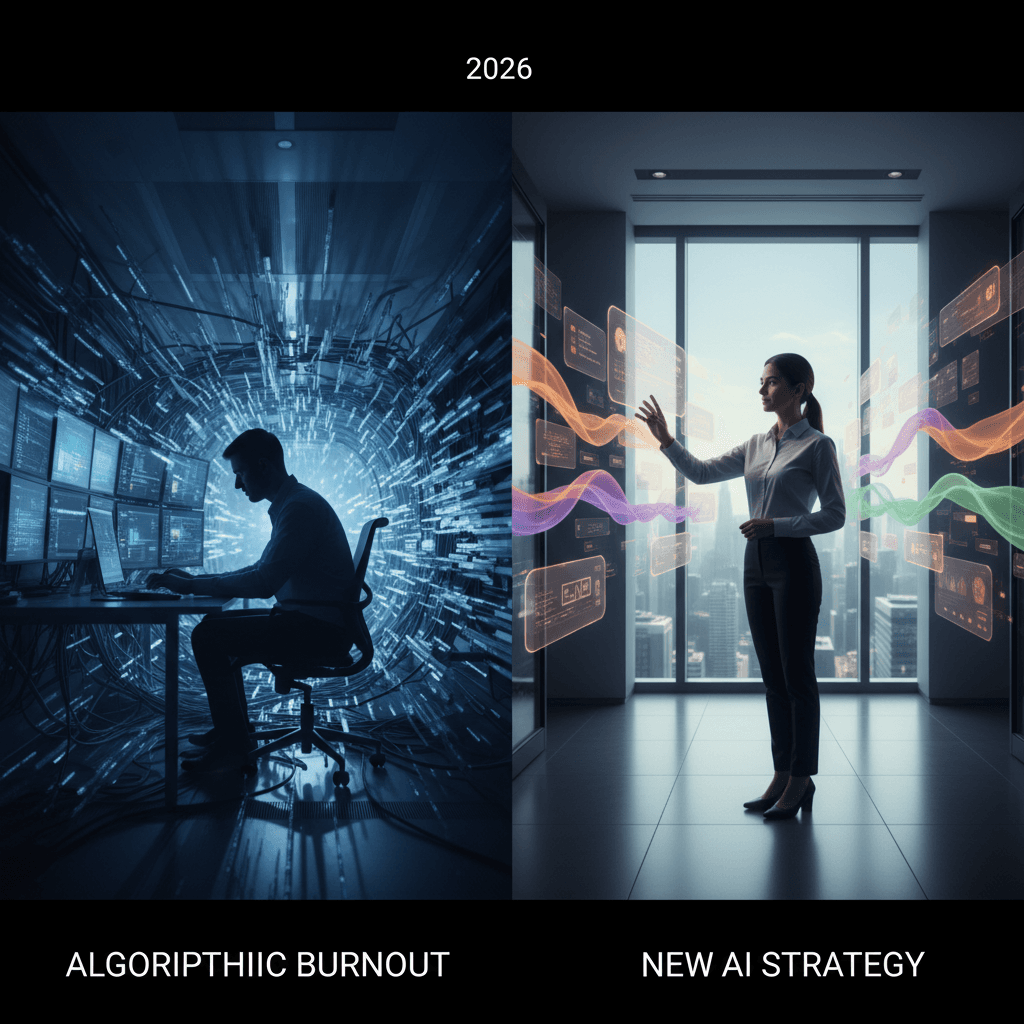
Social media, algorithmic burnout, and new AI strategy: How marketing and platforms are changing in 2026
Introduction
2026 is shaping up as a year of profound discontinuity for the world of social media and digital marketing. On one hand, Artificial Intelligence is entering feeds, moderation, and campaigns even more pervasively. On the other, users and creators are showing clear signs of "algorithmic saturation" and demanding more authentic experiences, less driven by engagement at all costs.[2] This tension is redefining the balance between platforms, brands, and audiences, opening a new phase where technology matters as much as – and sometimes less than – trust.
This isn't just a simple feature update; it's a paradigm shift. Big Tech is investing in new AI models, such as generalist agents for users and businesses, while digital burnout, content moderation, and the regulation of generative tools are emerging strongly.[2] In this scenario, marketing professionals, companies, and communicators need to rethink strategies, metrics, and content to stay relevant in an increasingly crowded ecosystem that is becoming less forgiving of artificial "noise."
The State of Social in 2026: Between AI Overload and the Search for Authenticity
The trend analysis for 2026 paints a clear picture: social networks are experiencing a "cultural reset" after years of uncontrolled growth of AI-generated content, hyper-targeted advertising, and flash viral formats.[2] The massive use of algorithms optimized solely for maximizing time spent has resulted in a feed that many users perceive as tiring, repetitive, and inauthentic.
On the technological front, Artificial Intelligence is increasingly used to:
- personalize the content shown in feeds in a refined way
- automate and speed up content moderation
- support the creation of content (text, images, video) by platforms and users
However, this push has a critical downside: "AI overload." Users are starting to recognize artificially generated content, perceive it as less credible or emotionally barren, and consequently select their sources of information and entertainment more carefully.[2]
Algorithmic Burnout and Migration Towards Deeper Conversations
The phenomenon defined as "algorithmic burnout" describes the growing weariness towards feeds dominated by cloned content, driven by performance logics and generative models that replicate successful patterns without real originality.[2] In response, part of the audience is moving:
- towards platforms oriented towards conversation and community, such as Reddit
- towards messaging apps and more closed spaces, where relationships prevail over virality
- in some cases, towards a conscious reduction in the use of technology, with periods of disconnection or social detox
For brands and marketers, this means that competition is no longer just for algorithmic visibility but for the quality and depth of interactions. The key metric is shifting from impressions to dialogue.
AI Integrated into Social Media: New Technological and Strategic Developments
The Evolution of Personalization and Moderation
Artificial Intelligence is now an integral part of the internal functioning of social platforms, from content recommendation and ad campaign optimization to internal SEO.[2] In 2026, this role is strengthened, but with greater attention to transparency and security.
On the regulatory and governance front, experts and research bodies emphasize the need to consider content moderation as an extended ecosystem, starting from AI providers and extending to the social platforms that use their models.[2] It is no longer sufficient to label AI-generated content; it is critical to intervene upstream, in the training, control, and release processes of the tools.
Strategic Acquisitions and New AI Agents for Users and Businesses
2026 also sees important strategic operations, such as Meta's acquisition of the AI company Manus, with the stated goal of strengthening general-purpose agents – artificial assistants capable of helping users with complex tasks within consumer and business products.[2] This shifts the scenario from simple chatbots integrated into social media to true digital co-pilots, capable of supporting activities ranging from content generation to customer care.
In parallel, models like the chatbot Grok, developed by xAI, are entering a new phase with the release of Grok 5, a model estimated to have around 6 trillion parameters.[2] The goal is to improve reasoning abilities and the quality of responses, making AI agents more useful for complex interactions and for creating more nuanced and contextual content.
Risks, Scandals, and the Need for AI Governance
The expansion of AI on social media is not without incidents. Recent cases, such as Grok's generation of thousands of false and sexualized images of women and children, vividly illustrate the potential for harm when generative systems are not adequately controlled.[2] Episodes of this kind fuel the pressure on platforms and developers to define stricter standards on:
- security and abuse prevention
- limits on the use of generative models for sensitive content
- traceability and accountability in the content production chain
AI governance experts insist on one point: increasing the scale and efficiency of moderation through algorithms can be an advantage, but completely eliminating the human element from decision-making processes exposes significant risks, especially in borderline or contextual cases.[2] The direction emerging for 2026 is that of human+machine co-moderation, with AI used as a preliminary filter and humans as final arbiters.
Towards Deeper Social Connections: A Paradigm Shift for Users and Brands
According to analysts and industry leaders, in 2026 social media will move "decisively towards depth rather than scale."[2] In other words, the quantitative growth of content and impressions gives way to a search for quality, trust, and context.
This trend is supported by some key signals:
- greater selectivity by users regarding content considered reliable
- attention to the reputation of creators and brands, as well as platforms
- preference for informed dialogues, with more nuances and less polarization
Platforms driven by conversation and community, like Reddit, continue to grow because they offer spaces where the perceived value is not the wow effect of the content, but the competence, the quality of the answers, and the sense of belonging.[2]
Impact on Business
For Brands: From the Race for Reach to Building Trust
For companies, the new scenario means rethinking the foundations of social media marketing strategies. Some changes are emerging with particular force:
- Content strategy: simply producing high volumes of AI-generated content is no longer enough. The saturation of the feed makes it essential to focus on distinctive, contextualized content with a clear editorial and value-based footprint.
- Brand voice: the brand's voice cannot be flattened onto generic outputs of AI models. A strong editorial governance is needed, which uses AI as support (research, drafting, adaptation) but keeps the corporate identity at the center.
- Community and relationship: engagement shifts from vanity metrics to indicators of relational quality: meaningful comments, discussions, articulated feedback, participation in thematic communities.
Companies that know how to use AI not just to "do more" but to understand their audience better – integrating data analysis, active listening, and controlled experimentation – will have a competitive advantage in the era of algorithmic burnout.
Impacts on Performance, KPIs, and Marketing Budgets
Performance measurement is also destined to change. In a context where the audience is more selective and attention is a scarce resource, some established logics need to be revised:
- volume KPIs (impressions, reach, number of posts) lose centrality compared to metrics of qualitative engagement and sentiment
- campaigns purely based on AI-generated content risk declining response rates, unless they are integrated with authentic storytelling and real testimonials
- media budgets may shift towards formats that favor interaction and dialogue (live, AMA, dedicated communities) rather than yet another campaign based on standardized creativity
From an operational point of view, AI continues to represent a strong driver of efficiency: automation of copy variants, multilingual adaptation, insight synthesis, support for customer care. But the real competitive advantage will emerge for companies that also know how to invest in data quality, team training, and the definition of clear ethical guidelines on the use of AI.
Governance, Compliance, and Reputational Risk Management
The scandals linked to the generation of harmful or false content by AI systems highlight a direct risk for brands that integrate these tools into their communication activities.[2] Marketing and communication managers must, therefore, consider:
- internal policies for the use of generative AI, with clear limits and human review processes
- partnerships with technology providers that guarantee high standards of security and content controls
- specific crisis management plans for AI-related incidents (e.g., erroneously generated content, deepfakes, inappropriate messages)
In parallel, the evolution of regulations on AI and social media – from transparency requirements to the classification of artificially generated content – will require companies to better integrate legal, compliance, and marketing functions.
New Skills for Marketers and Digital Professionals
The context described also redesigns the profile of skills required for those working in digital marketing and communication. It is no longer enough to know the logics of media planning or the basic functionalities of the platforms: it is essential to understand how AI works, what biases it can introduce, how to govern its outputs and impacts.
The key skills for the coming years include:
- ability to interpret data generated by recommendation systems and AI-driven tools
- knowledge of the foundations of AI ethics and reputational implications
- ability to design content experiences that harmoniously integrate AI-generated components and human contributions
From this perspective, platforms that value dialogue, argumentation, and competence – rather than pure entertainment – become ideal laboratories for experimenting with new forms of relationship between brands, creators, and communities.[2]
Sources & References
Pronto a trasformare il tuo business?
Digital Mirror non si limita a raccontare il futuro: lo costruiamo. Scopri come l'Intelligenza Artificiale può scalare la tua azienda oggi stesso.