AI Overview
The article describes how 2025 is defined as the "year zero" of artificial intelligence for logistics, based on data showing a doubling of AI adoption by Italian companies. It analyzes why logistics, under pressure from costs, volatility, and service requests, has become the ideal ground for predictive algorithms, route optimization, and warehouse automation. It explains how AI is acting as a new decision-making infrastructure for supply chains, integrating with existing systems and transforming data flows into operational choices. The piece then delves into the European and Italian regulatory framework, the risks and barriers to adoption, and especially the concrete impact on efficiency, margins, and new service models. The result is a clear and accessible picture of a profound revolution that is often invisible to the end consumer.
AI and Logistics: 2025 as Year Zero of the Supply Chain Revolution
In 2025, artificial intelligence is entering logistics and freight transport in a systematic way, transforming supply chains, ports, warehouses, and entire production chains. According to recent analyses based on ISTAT data, the adoption of AI by Italian companies has almost doubled within a year, and logistics is emerging as one of the most dynamic laboratories of this transformation, encompassing operational automation, predictive optimization, and new business models.[3][9]
Today's News: Logistics Discovers AI as a Critical Infrastructure
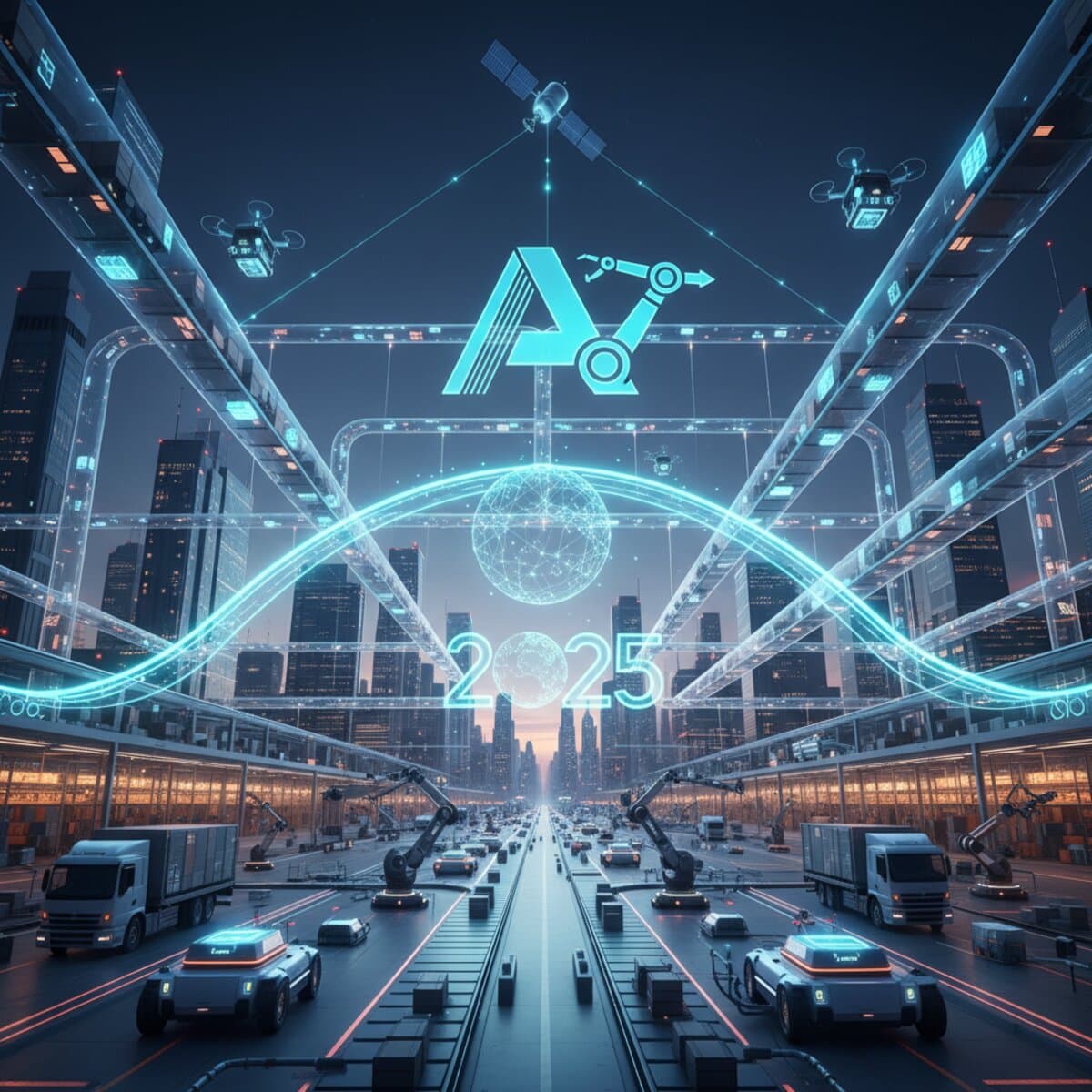
Latest industry analyses openly speak of an "ongoing revolution" linked to the increasing application of artificial intelligence in logistics and freight transport, to the point of defining 2025 as "year zero of AI for logistics."[9] This definition is not a rhetorical device but is based on a measurable change of scale.
According to data from the ISTAT survey "Enterprises and ICT – Year 2025", 16.4% of Italian companies with at least 10 employees use at least one artificial intelligence technology, almost double the 8.2% in 2024 and more than three times the 5% in 2023.[3] This acceleration is not evenly distributed; logistics, transport, and related supply chains (manufacturing, retail, e‑commerce) are among the most exposed to the need to optimize costs, times, and resilience, and therefore among the most likely to experiment with AI solutions.[1][9]
Why Logistics Has Become the Proving Ground for Artificial Intelligence
Structural Pressures on Supply Chains
Supply chains, already stressed by geopolitical crises, energy cost volatility, and unpredictable demand peaks, now operate in a context of reduced margins and increasing service expectations. Four forces are driving logistics operators and manufacturing companies towards AI:
- Demand variability: incorrect estimates generate overstocking or stock‑outs, with direct impacts on revenues and working capital.[1]
- Infrastructural congestion: ports, intermodal hubs, and urban hubs must orchestrate increasingly complex flows in finite spaces.
- Cost pressure: fuel, specialized labor, handling, and warehousing require a structural reduction in waste.
- Regulatory constraints and sustainability: emission reduction targets and new European rules penalize inefficient and poorly traceable models.[1]
In this context, AI is not perceived merely as a "nice to have" technology but as a decision-making infrastructure capable of transforming heterogeneous data (IoT sensors, TMS/WMS systems, ERP, weather data, traffic) into automatic or semi-automatic operational decisions.[1][9]
From Data to Automated Decision Making
The solutions described by industry analysis revolve around three main axes:
- Predictive analysis: models that estimate future demand, transit times, probability of delays, saturation of warehouses and vehicles.[1][9]
- Real-time optimization: algorithms that recalculate routes, loading plans, and picking sequences when external conditions change (traffic, weather, breakdowns, order cancellations).[1]
- Intelligent automation: systems that not only collect data but also directly activate actions (e.g., automatic reassignment of containers, rescheduling of slots at the dock, reconfiguration of shifts in the warehouse).[1][9]
This combination explains why 2025 is being portrayed as a turning point: the shift is from isolated pilot projects to AI platforms integrated into the operational core of value chains.[1]
What Logistics Companies Are Actually Doing
Optimization of Transport and Routes
In land, sea, and intermodal transport, AI is used for:
- Dynamic routing of vehicles: systems that calculate optimal routes based on traffic, delivery time windows, service priorities, and vehicle constraints (e.g., ADR, height, weight), updating routes in real-time.[1][9]
- Intelligent load consolidation: models that combine orders from different customers to maximize the filling coefficient of containers, trucks, and pallets, reducing empty trips and costs per unit transported.[1]
- Prediction of arrival times (ETA): algorithms that integrate data from GPS, port community systems, weather conditions, and historical delays to provide more accurate ETAs, improving downstream planning (warehouses, factories, points of sale).[9]
For logistics operators, this translates into fewer kilometers traveled, lower fuel consumption, reduction of penalizing delays on contracts, and a greater ability to promise realistic and competitive delivery times.
Intelligent Warehouses and Adaptive Automation
In warehouses, AI is used to coordinate:
- Automated picking systems (from sorters to shuttles to autonomous mobile robots), which must move in a coordinated manner with human operators, reducing downtime and path conflicts.[1]
- Dynamic allocation of stock: positioning items on shelves based on predicted demand and frequency of picking, with the aim of reducing the average picking time and bottlenecks in the busiest areas.[1]
- Predictive maintenance of equipment: IoT sensors and predictive models identify anomalous patterns in motors, belts, and trolleys, planning interventions before a costly plant shutdown occurs.[1][9]
In this context, artificial intelligence does not replace traditional WMS but overlaps as a layer of continuous optimization, capable of learning from real flows and adapting operating rules without constant manual intervention.[1]
Urban Logistics and Last Mile
The explosion of e‑commerce has amplified the complexity of the last mile. AI is used for:
- Micro‑planning of urban deliveries: automatic reassignment of rounds based on failed deliveries, customer-booked slots, and access restrictions (restricted traffic zones, loading/unloading times).[1]
- Scenario simulation: analysis of what would happen by moving an urban hub, changing delivery times, or introducing new vehicles (e‑vans, cargo bikes), to support investment decisions and agreements with local administrations.[1]
- Monitoring of customer experience: integration of tracking data, feedback, and complaints to identify patterns of service disruption and intervene on critical routes, branches, or partners.[1]
Regulatory Framework and Responsible Governance
The transformation of logistics takes place within an increasingly complex European and national regulatory framework.
At the EU level, the AI Act introduces a risk-based approach, with specific obligations for high-impact systems in terms of safety, fundamental rights, and reliability.[1][2] In the logistics sector, this translates into the need to carefully assess:
- automated surveillance systems in logistics hubs;
- scoring algorithms that affect the allocation of loads or work shifts;
- automatic decision systems that may impact safety, customs compliance, or export controls.[1][2]
In Italy, the national law on artificial intelligence n. 132/2025 defines general principles for AI research, development, and adoption, reinforcing the centrality of human responsibility, the traceability of automated decisions, and consistency with the GDPR and the European AI Act.[2] Two public agencies are called upon to oversee governance and notifications, involving also businesses and public administrations.[2]
For logistics operators, this means that AI projects must be developed with decision logs, auditability of models, rigorous management of personal data, and clear roles of responsibility between technology providers and user companies.[1][2]
Impact on Business
Operational Efficiency and Margins
The adoption of AI in logistics has a direct impact on operating costs, service quality, and the ability to scale the business. The increase in companies using AI – from 5% in 2023 to 8.2% in 2024 up to 16.4% in 2025 – reflects the perception of AI as an economic lever rather than a simple technological innovation.[3][5]
The main impacts include:
- Reduction of transport costs thanks to route optimization, reduction of empty trips, and better utilization of vehicles.[1][9]
- Decrease in operational downtime through predictive maintenance on fleets and handling equipment.[1]
- Better use of assets (warehouses, docks, loading bays) thanks to algorithmic planning of inbound and outbound flows.[1][9]
For logistics customer companies (manufacturing, retail, e‑commerce), this translates into more stable lead times, fewer stockouts, and a more predictable relationship between logistics costs and turnover.
New Service Metrics and Competitive Advantage
Artificial intelligence shifts the focus from traditional metrics alone (cost per delivery, punctuality) to more sophisticated indicators:
- accuracy of demand forecasts;
- accuracy of ETAs communicated to customers;
- resilience of the supply chain in the face of unforeseen shocks (weather events, sudden closures of infrastructure, demand peaks).[1][9]
Operators who manage to integrate AI in a mature way can:
- propose premium services (e.g., ultra-narrow delivery windows guaranteed by advanced routing algorithms);
- offer end‑to-end visibility along the chain, unifying data from different partners under a single analytical platform;
- monetize their logistics data, transforming it into consulting and forecasting services for industrial customers.[1]
ROI, Risks, and Barriers to Adoption
Despite the growth, analysts point out that AI is still far from widespread adoption.[3] The main barriers include:
- complexity of integration with legacy systems (TMS, WMS, ERP);
- lack of internal skills to evaluate, train, and govern AI models;
- regulatory and reputational uncertainty: fear of implementing systems perceived as opaque or potentially discriminatory towards workers and partners.[1][2]
To obtain a sustainable return on investment, the most advanced companies are adopting a gradual approach:
- starting from high-impact but confined use cases (e.g., predictive maintenance on a specific sorting line);
- rigorous measurement of KPIs before and after AI;
- progressive extension of the models, once the economic and operational benefit has been validated.[1]
Role of Technology Partners and Collaborative Supply Chains
Empirical evidence shows that most logistics AI projects originate from ecosystems that involve:
- logistics operators;
- cloud and AI platform providers;
- system integrators;
- sometimes universities and research centers for advanced modeling.[1][9]
This approach allows data sharing, better allocation of development costs, and accelerates the experimentation phase, while maintaining clear rules on intellectual property, privacy, and data security. For companies in the supply chain, the ability to sit at this ecosystem table is already a competitive factor as important as the size of their fleet or the square footage of warehouses and hubs.[1]
A Rapidly Maturing Scenario
The most recent analyses indicate that in 2025 the content generated by AI has become massive on the web, pushing platforms and companies to focus on quality and the more mature use of technologies.[6] In the world of logistics and supply chains, this maturation translates into the shift of AI from marketing and superficial experimentation to the backbone of critical processes: planning, transport, warehouse, last mile.[1][6][9]
The “year zero” of AI for logistics, described by industry sources, therefore represents less a point of arrival and more the beginning of a phase in which the competitiveness of companies and entire supply chains will also be measured by their ability to:
- build solid data infrastructures;
- integrate predictive and decision-making models into daily processes;
- govern risks and responsibilities in an increasingly demanding regulatory framework.[1][2][9]
For professionals, managers, and companies, the message is clear: logistics is no longer just a support function, but the proving ground in which artificial intelligence demonstrates – with numbers and operational results – its ability to redefine the perimeter of the business.
Sources & References
Pronto a trasformare il tuo business?
Digital Mirror non si limita a raccontare il futuro: lo costruiamo. Scopri come l'Intelligenza Artificiale può scalare la tua azienda oggi stesso.